


Generally, in all cyclones, the air entering the system spirals downward as a result of the system’s cylindrical structure. During this process, dust particles hitting the inner surface lose their velocity and settle downward from the body. The dust that settles into the cone at the bottom is discharged from there and removed from the system.
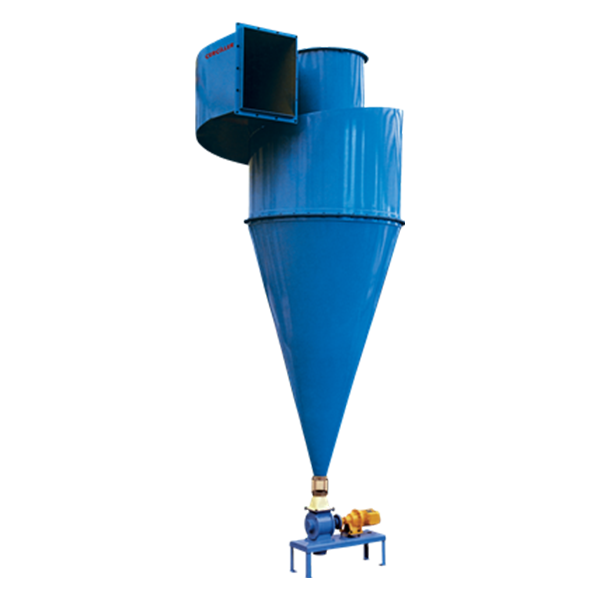
CYCLONE FILTER
Generally, in all cyclones, the air entering the system spirals downward as a result of the system’s cylindrical structure. During this process, dust particles hitting the inner surface lose their velocity and settle downward from the body. The dust that settles into the cone at the bottom is discharged and removed from the system. The air, which initially moved downward, then exits the system through the central cylindrical pipe—the only outlet—by spiraling upward again.
Cyclones have become the most widely used systems for particle removal. In these systems, the mass collision of particles plays a key role in removing them from the waste gas. The particle removal efficiency of cyclones depends on the angular velocity within the body. As the rotational speed of the gas—and thus the particles within it—increases inside the cyclone, the probability of smaller particles hitting the inner side walls increases, thereby enhancing efficiency. The inlet structure is generally designed in a tangential, helical, or internal spiral shape. Sometimes, vanes are used to facilitate the spiraling movement of the gas and to reduce pressure drops. The dust collection efficiency of a cyclone increases with the increase in the aerodynamic diameter and density of the particles.
Cyclones are generally used to separate dust particles larger than 5 microns from waste gas. Therefore, in terms of dust separation efficiency, cyclones rank between gravitational settling systems and electrostatic precipitators. They are mostly used as pre-separators before electrostatic precipitators.
Areas of Use: Metal Industry, Mining Industry, Food Industry, Foundry Industry, Wood Sawdust, etc.